
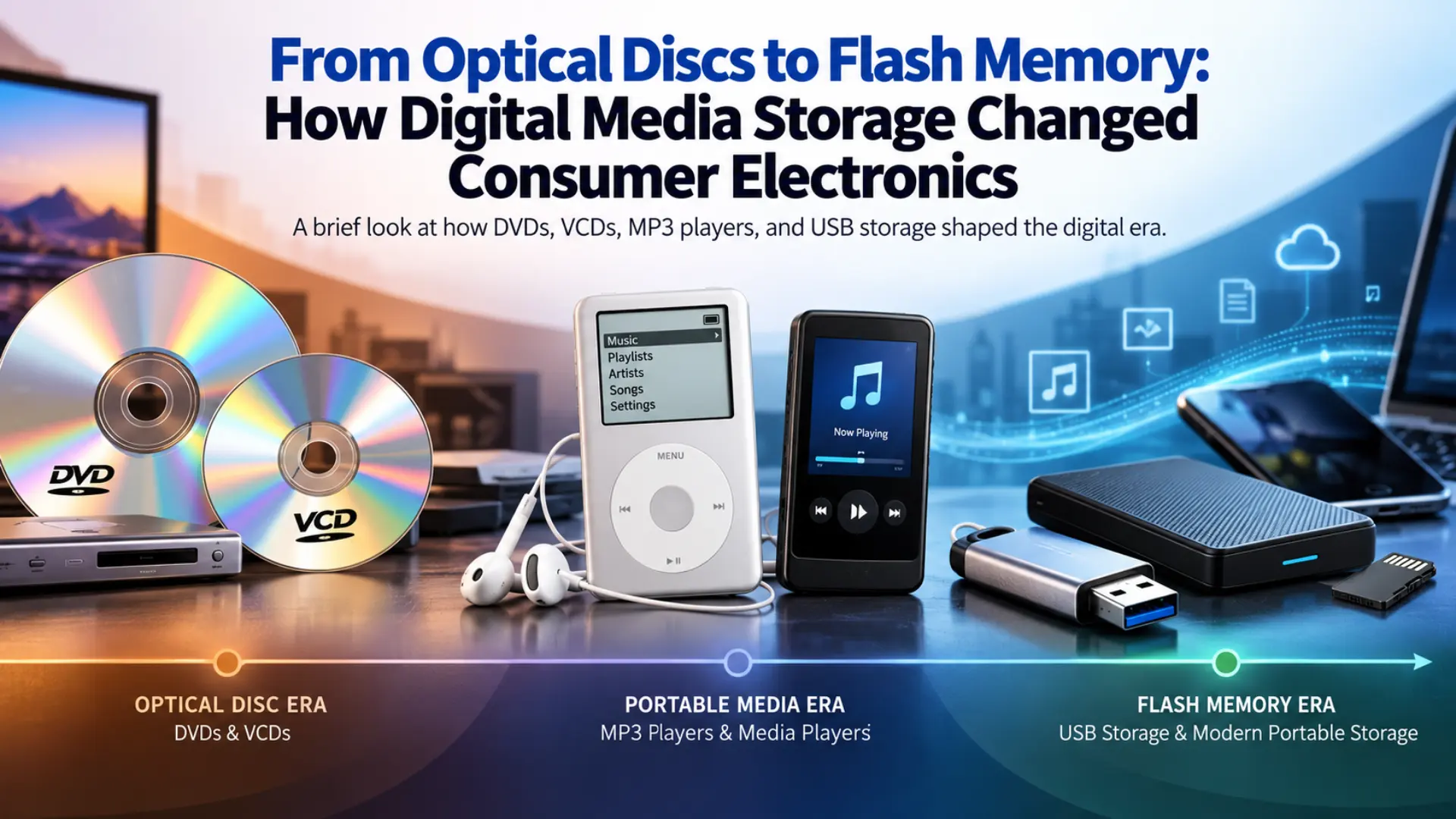
Digital storage technology has transformed how people record, transport, and access music, video, photographs, and personal information. During the 1990s and early 2000s, physical media such as compact discs and DVDs were widely used for distributing entertainment and computer software. As digital compression improved, portable music players made it possible to store collections of audio files on increasingly compact devices. USB flash drives later became a familiar method of transferring information between computers and other compatible electronic equipment. These developments changed everyday expectations about portability, storage capacity, and access to digital content. The progression from optical media to semiconductor memory also influenced the design of computers, televisions, and home entertainment systems.
Different storage technologies developed because they addressed different limitations in cost, capacity, durability, and convenience. Optical discs provided a practical way to distribute prerecorded information in a standardized physical format, while flash memory supported direct electronic access without moving optical components. Improvements in semiconductor manufacturing gradually increased available storage capacities and expanded the use of solid-state memory in consumer equipment. At the same time, faster interfaces and more efficient file formats made digital information easier to move between devices. Network-based services eventually reduced dependence on physical media for many entertainment activities, although local storage continues to serve important purposes. Examining these transitions reveals how changes in storage technology influenced the broader evolution of consumer electronics.
The Role of CDs, VCDs, and DVDs in Digital Entertainment
The compact disc was introduced commercially in the early 1980s as a format for distributing digital audio recordings. Its optical recording system used a laser to read information stored along a spiral track on the disc surface. Related CD formats later supported computer software, digital files, and compressed video recordings. Video CD, or VCD, used MPEG-1 compression to store moving images and audio in a format suitable for compatible playback equipment. A common recordable CD provides approximately 700 megabytes of storage, although capacities and recording characteristics can differ between disc types. The standardized physical dimensions of compact discs made them practical for manufacturing, packaging, and distribution.
DVD technology expanded the possibilities of optical media by providing substantially greater storage capacity within a disc of similar physical size. A conventional single-layer DVD stores approximately 4.7 gigabytes of data, allowing longer video programs and additional content to be distributed on one disc. DVD-Video commonly used MPEG-2 compression and could support features such as subtitles, multiple audio tracks, and navigation menus. These capabilities helped establish DVDs as a major home entertainment format before widespread broadband streaming. Nevertheless, optical media depend on suitable playback hardware, and scratches, disc deterioration, or mechanical problems can interfere with access to recorded content. Differences in regional coding, disc recording formats, and player specifications can also limit compatibility.
How MP3 Compression Influenced Portable Music
The development of digital audio compression made portable music storage more practical by reducing the amount of data needed for a recording. Uncompressed digital audio can require substantial storage space, particularly when recordings use higher sampling rates or multiple channels. MP3 addresses this limitation through a lossy compression process that removes or simplifies selected audio information based on perceptual coding principles. The format became widely adopted because it could produce relatively small audio files while maintaining acceptable listening quality for many applications. As memory capacities increased, portable music players were able to accommodate growing collections of songs without requiring individual audio discs. These changes helped make file-based music libraries a common part of everyday digital entertainment.
The bitrate selected during MP3 encoding influences the relationship between file size and audio quality. Lower bitrates generally produce smaller files, but they may also introduce audible compression artifacts, especially with complex musical material. Higher bitrates preserve more encoded information while requiring additional storage space, although the quality difference is not equally noticeable in every listening situation. Actual playback quality also depends on the original recording, the encoding process, and the performance of the connected headphones or speakers. Other formats, including AAC, FLAC, and WAV, provide different approaches to audio compression and storage, with FLAC supporting lossless compression and WAV commonly used as a container for uncompressed audio. The continuing use of these formats demonstrates that storage efficiency, fidelity, and compatibility remain distinct considerations in digital sound reproduction.
Why USB Flash Drives Became Everyday Storage Devices
USB flash drives became popular because they combined compact physical dimensions with reusable electronic storage. These devices use non-volatile flash memory, which retains stored information without continuous electrical power. A memory controller manages communication with the host device and coordinates operations involving the underlying flash memory. Unlike optical discs, USB flash drives do not require a laser-based reading mechanism, and their contents can ordinarily be updated through standard file operations. As USB interfaces spread across personal computers and consumer electronics, removable flash storage became increasingly convenient for transferring documents, photographs, and multimedia files. Its practical uses expanded into software installation, offline backups, media playback, and system recovery tasks.
Despite their convenience, USB flash drives are not universally compatible with every electronic device. Compatibility depends on factors such as the supported USB protocol, connector type, storage capacity, file system, and available electrical power. FAT32 has historically been supported by a broad range of devices, but it cannot store an individual file larger than four gibibytes minus one byte. ExFAT was designed to address limitations associated with older FAT file systems and is widely used for removable storage, although support varies among older devices. The transfer speed advertised for a USB standard also does not guarantee the same real-world performance from every flash drive. Safe removal procedures and regular backups remain important because interrupted write operations, controller failures, or physical damage can result in data loss.
The Importance of Device Compatibility and Technical Standards
Digital media compatibility involves more than whether a storage device can be physically connected to a television, computer, or playback system. A device must also recognize the storage format and understand the data structures used to organize its contents. For media playback, the system generally requires support for the relevant container format and the codecs used to encode audio or video streams. An MP4 file, for example, may contain different combinations of video and audio codecs, so recognizing the filename extension alone does not guarantee successful playback. Older equipment may have restrictions related to storage capacity, video resolution, supported codecs, or file naming conventions. These limitations help explain why a file that works on one device may fail to open on another.
Technical standards reduce compatibility problems by defining common methods of communication, encoding, and data organization. The USB family specifies aspects of device connectivity and communication, while audiovisual standards establish ways to represent and transport digital media. However, the existence of a standard does not mean that every product implements all available features or later revisions. Manufacturers select particular hardware capabilities and software functions according to their product designs and intended uses. As a result, original documentation remains essential when determining the precise capabilities of older electronic equipment. Understanding these differences can help users avoid unnecessary file conversions, unsuitable accessories, and incorrect assumptions about device functionality.
Preserving Digital Information and Reducing Electronic Waste
Digital storage media should not be treated as permanently reliable simply because they do not show visible signs of damage. Optical discs can deteriorate through physical wear, chemical changes, or unsuitable environmental conditions, while flash memory can experience data-retention problems and component failure. The longevity of stored information depends on the media type, manufacturing quality, operating conditions, and storage environment. Important files should therefore be maintained in more than one location, preferably using separate storage devices or independent storage services. Periodic verification is useful because the existence of a stored file does not guarantee that its contents remain readable. Migrating valuable information to supported contemporary formats can also reduce the risk of losing access when older hardware becomes difficult to maintain.
The environmental impact of consumer electronics extends beyond the period when a device is actively used. Manufacturing electronic equipment requires raw materials, energy, specialized components, and transportation throughout the supply chain. Discarded devices may contain recoverable metals, plastics, glass, and other materials, alongside substances that require appropriate handling. Responsible collection and recycling systems can recover useful resources and reduce the risks associated with unsuitable disposal methods. Extending the usable life of compatible equipment, maintaining reliable backups, and selecting appropriate recycling services are practical ways to support more responsible technology use. The history of digital media shows that technological progress involves not only greater capacity and convenience, but also continuing responsibilities for information preservation and electronic waste management.